-
Project: The UnConventional Center
Institution: University of Cincinnati
Typology: Master of Architecture Thesis
Location: Seattle, Washington
Completion: April 2021
Committee: Edward Mitchell, M.Arch (Chair); Vincent Sansalone, M.Arch
Honors & Recognition: Outstanding Thesis Award
Focus: Architectural plurality, internalized urbanism, and the relationship between corporate infrastructure and the city.Core Research: An investigation into the convention center as a self-contained temporary utopia that intensifies urban effects and challenges corporate infrastructure and functional fragmentation.
Curatorial Note: A visual thesis unfolding through drawings, representations, and captions that trace the internalized worlds, contradictions, and intensified urban effects of the UnConventional Center.
The UnConventional Center
Institution
University of Cincinnati
Typology
Master of Architecture Thesis
Location
Seattle, Washington
Project Completion
April 2021
Honors & Recognition
Outstanding Thesis Award
“The city is no longer. We can leave the theater now.” — Rem Koolhaas, S, M, L, XL
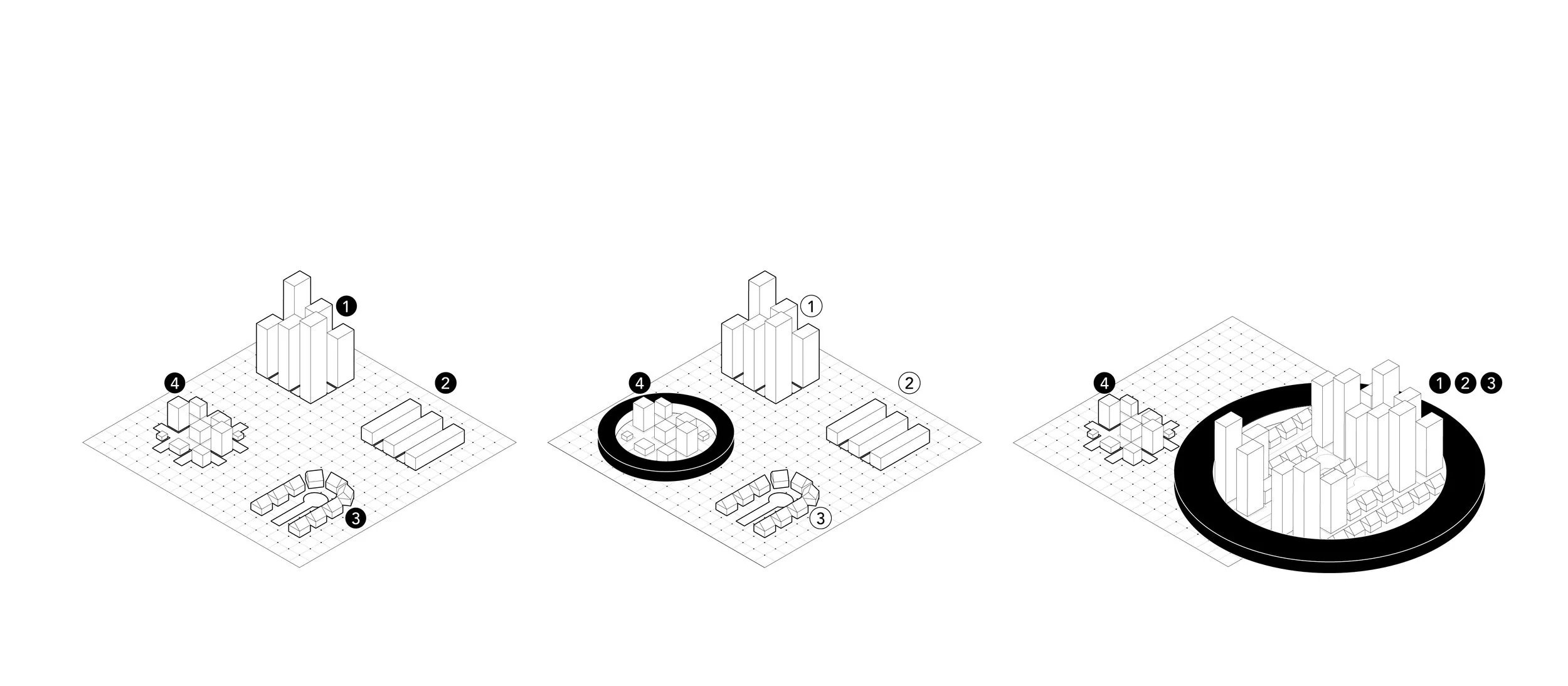
Operating on the premise that the traditional city is defunct, the project emerges as a self-contained world designed to challenge fragmented urban life. Envisioned as a counterpoint to Seattle’s corporate-driven infrastructure, the architecture critiques the compartmentalization of public life within sanitized urban enclaves. The design occupies a spatial paradox—simultaneously of the city, yet fundamentally outside.
Interior environments collide conventional and unconventional spatial logics, assembling urban effects to construct a model of collective experience. Rather than rigid, functionally determined programming, the project prioritizes a diversified spatial system capable of producing shifting use and identity.
Ultimately, the project operates as a speculative intervention, where constructed environments assemble a unified collective condition. By engaging a latent desire for urbanity within an overlooked civic typology, the UnConventional Center proposes a temporary utopia—an ecosystem that reimagines collective urban life beyond the limitations of the contemporary city.
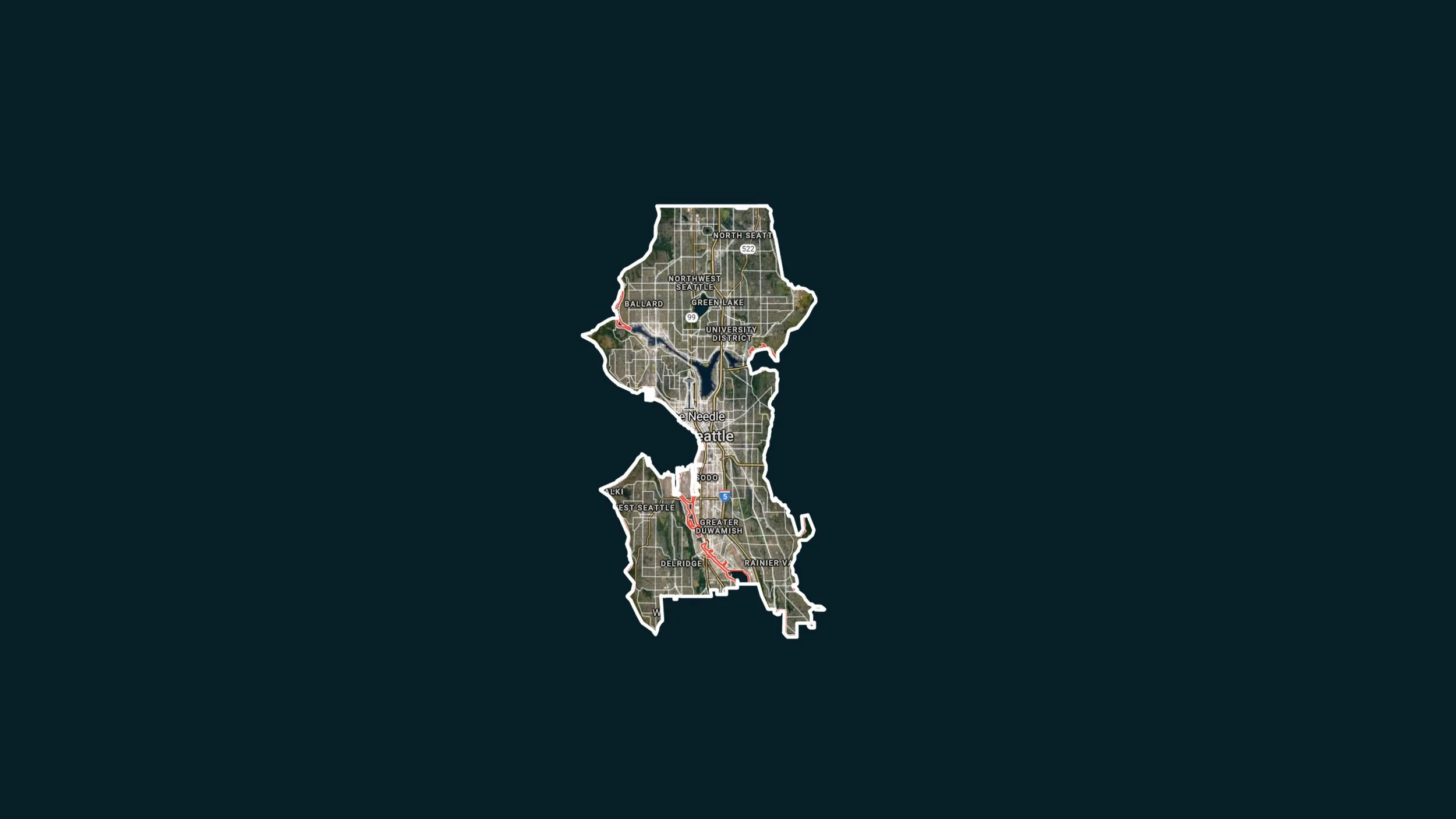
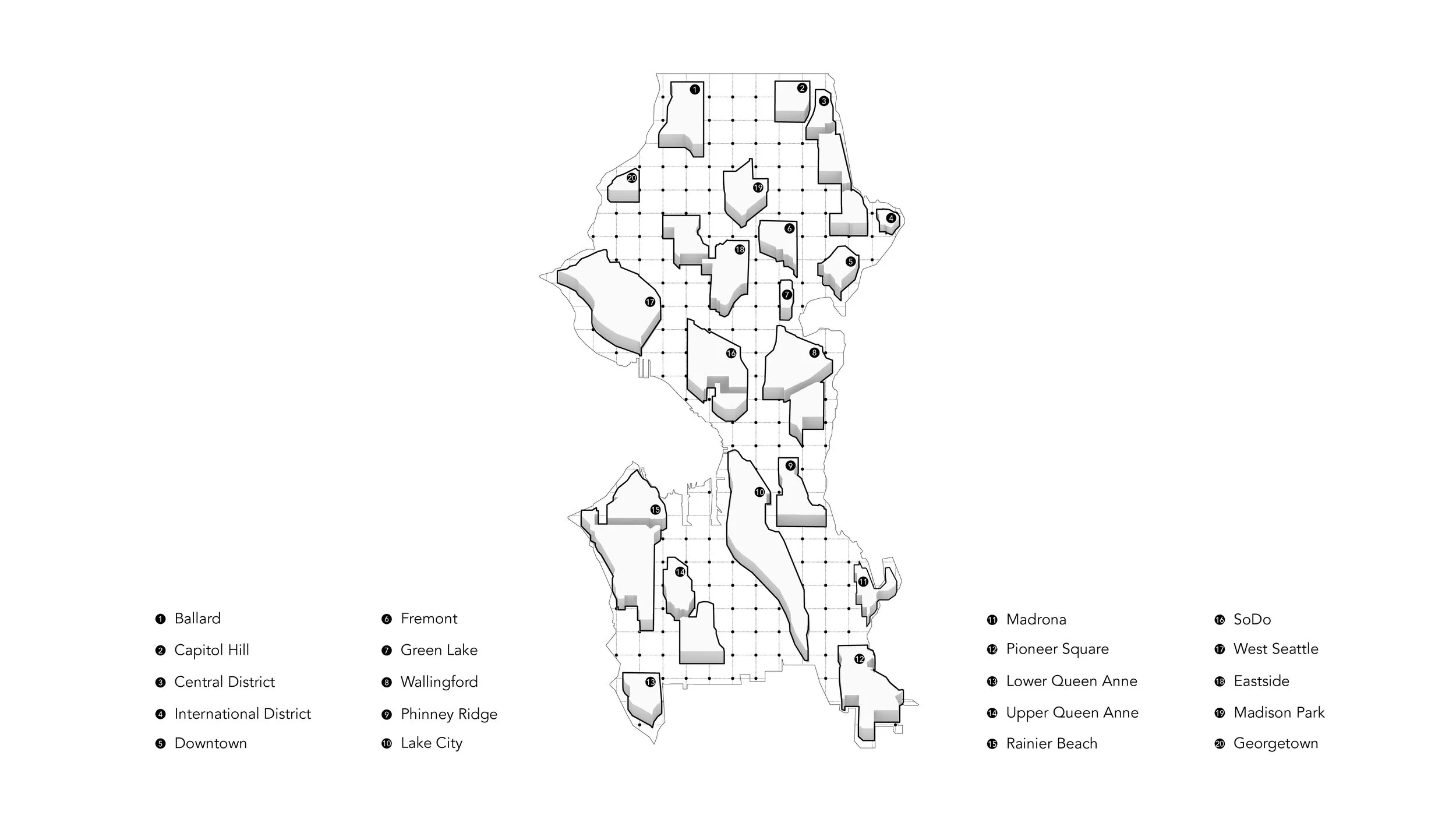
This project tests the role of architecture within the fragmented city of Seattle, Washington. The city operates as a system of separations—geographically, socially, and politically—shaping how it is experienced and understood.
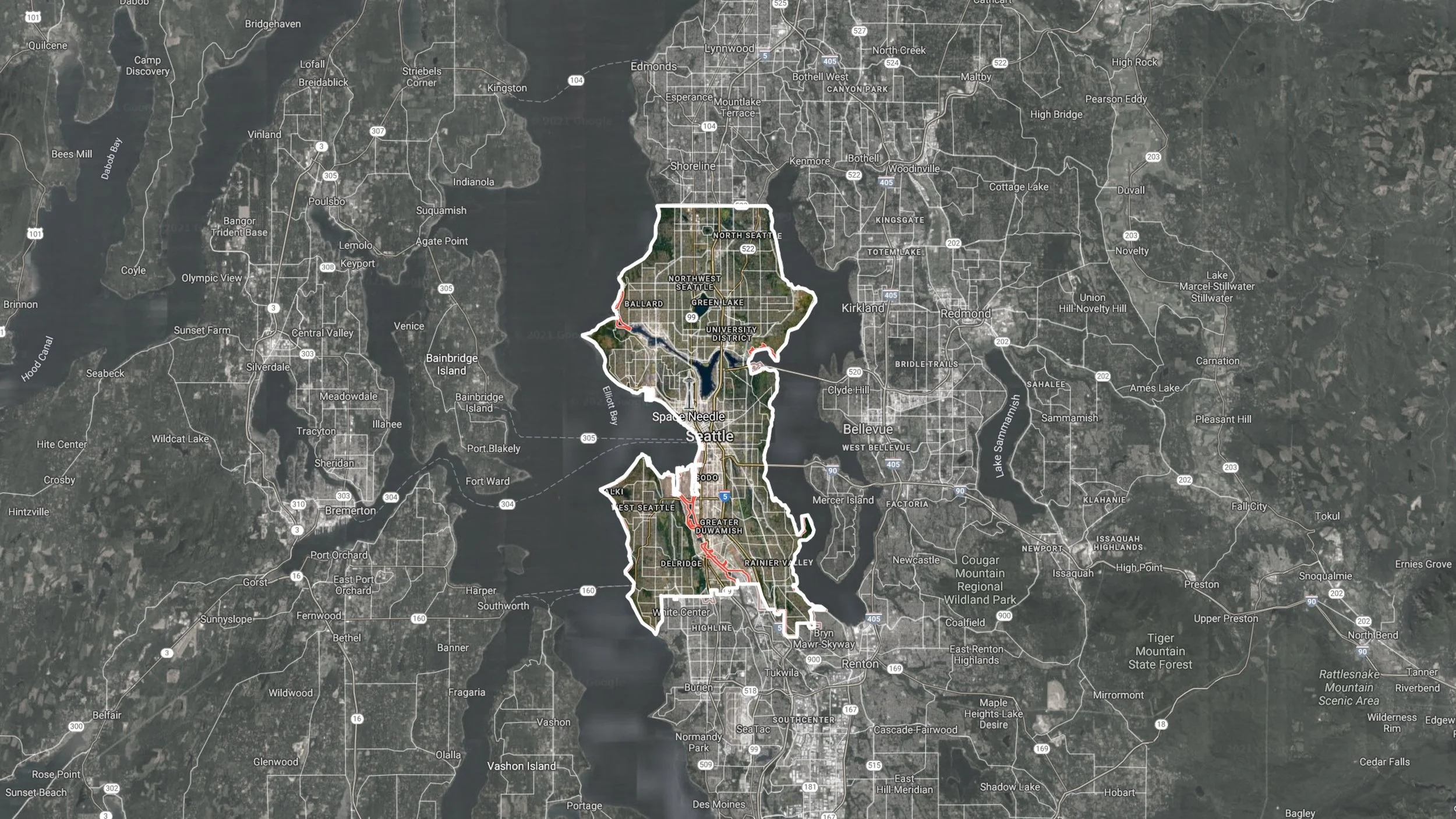
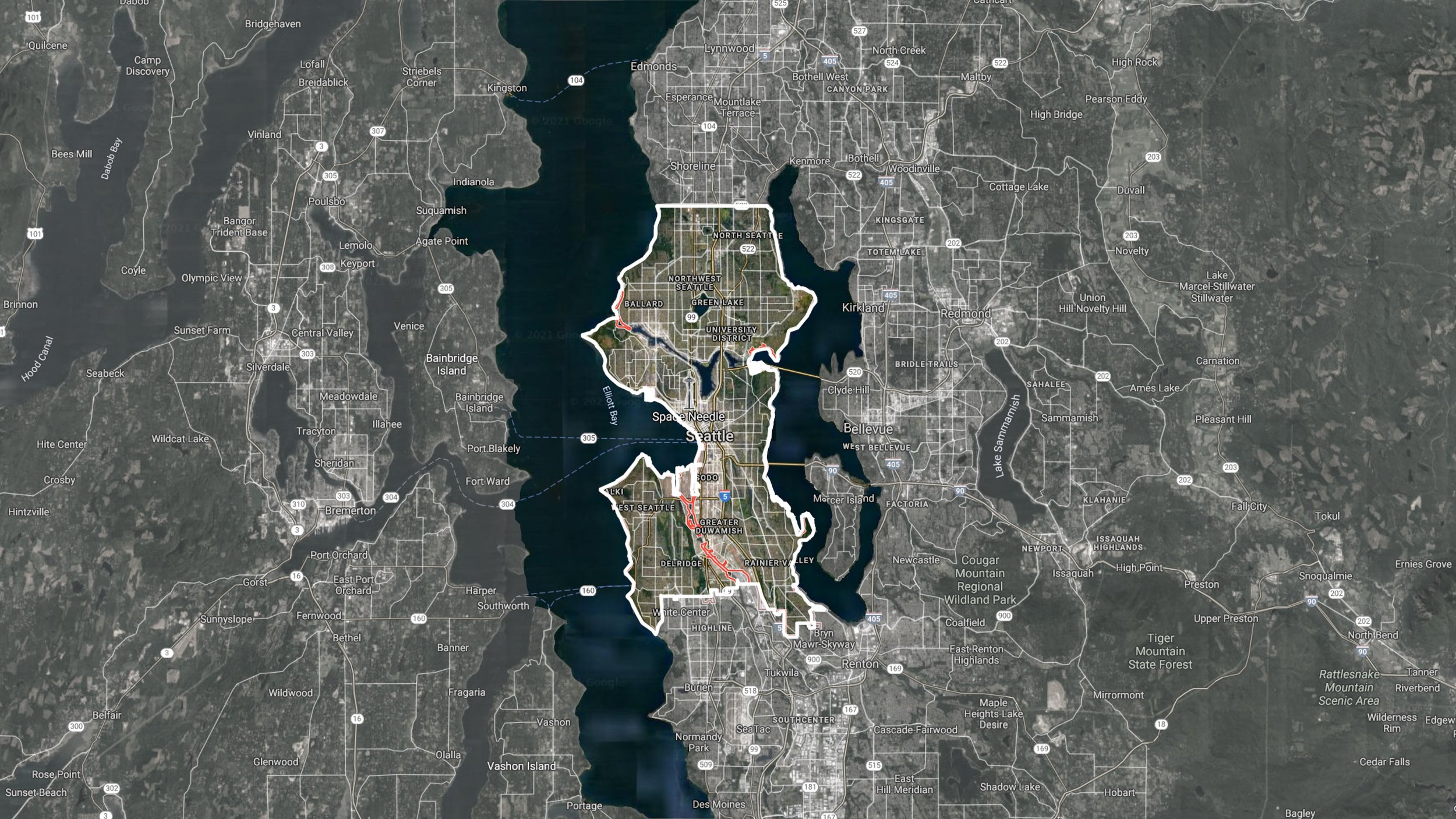
Geographically, the city occupies a narrow strip of land between Puget Sound and Lake Washington. It exists between urban intensity and immediate proximity to nature, structured by hills and shaped by water.

The island-like qualities of the city contribute to a condition of density in isolation.

Socially, Seattle operates as a city of neighborhoods. As it has developed, the boundaries between them have been shaped more by local perception than formal planning. With a repeatable framework of services, each neighborhood develops a distinct identity through its presentation and use.
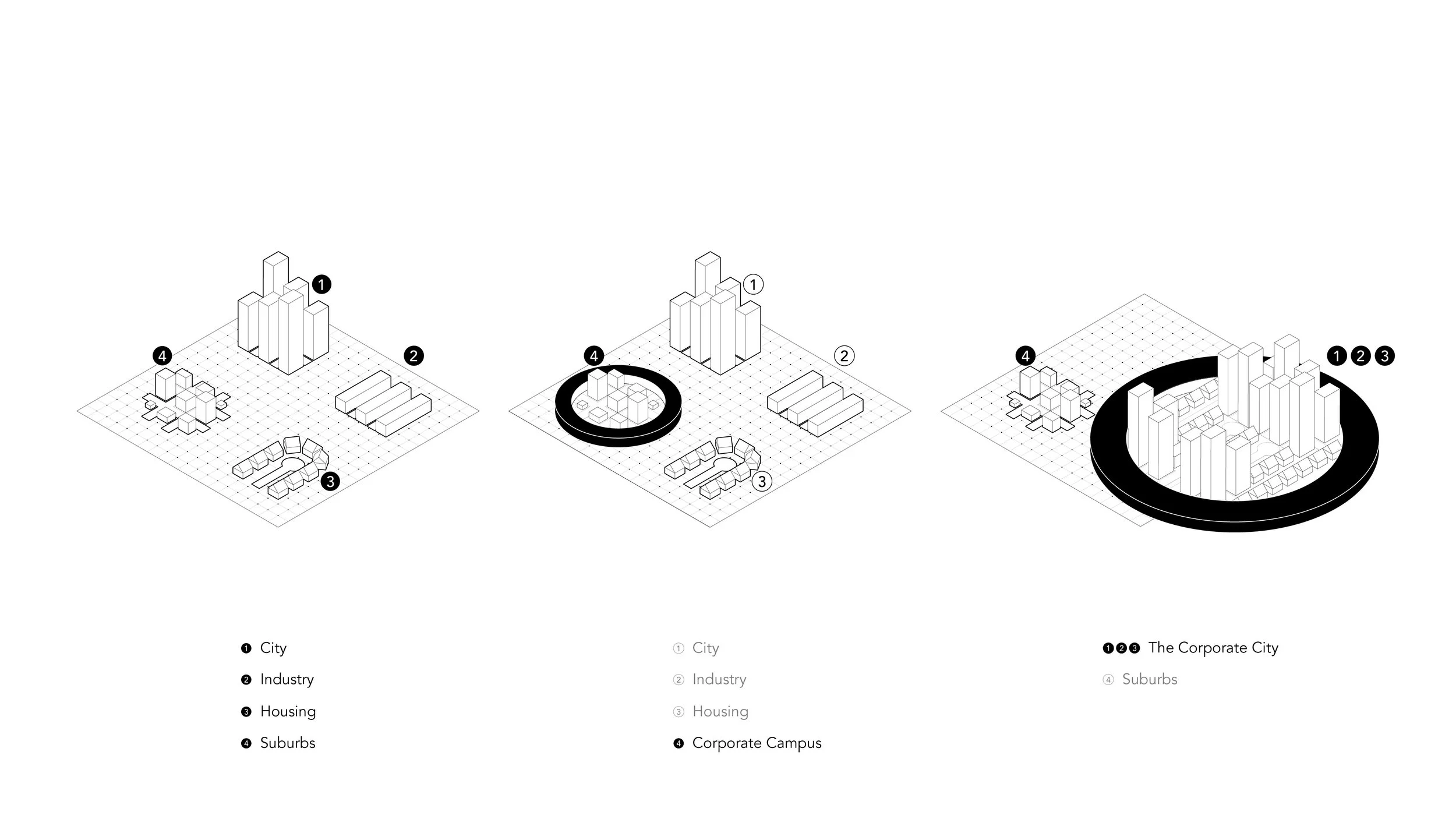
While often associated with the past, the company town remains present in Seattle today. This project extends the logic of the company town into a contemporary condition in which the city is heavily shaped by corporate influence. Corporate presence operates as a primary infrastructure for spatial and social change, particularly through the dominance of technology firms that have positioned Seattle as a contemporary high-tech center. As these corporations consolidate within downtown blocks, they reshape the structure and identity of the city.
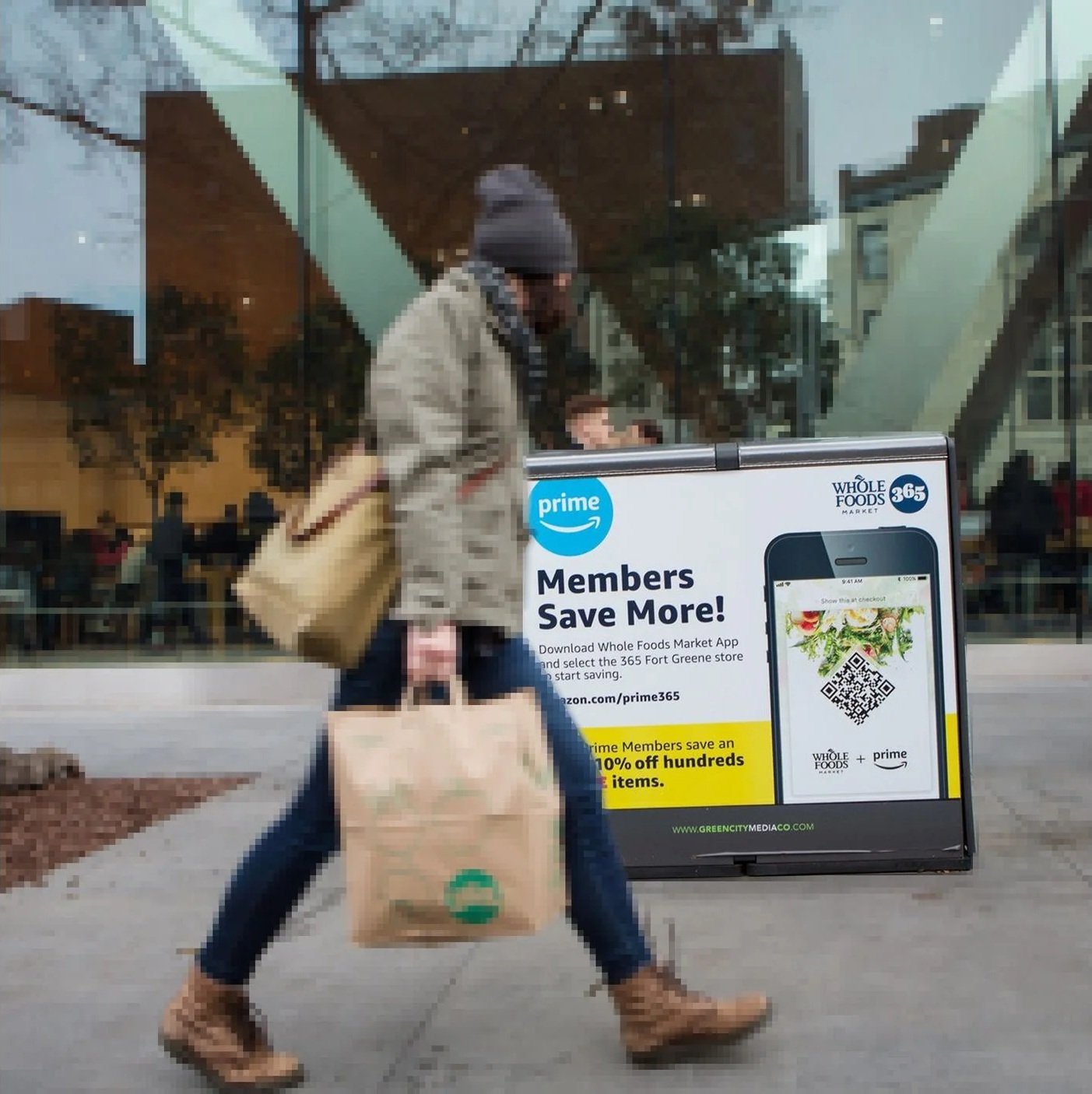
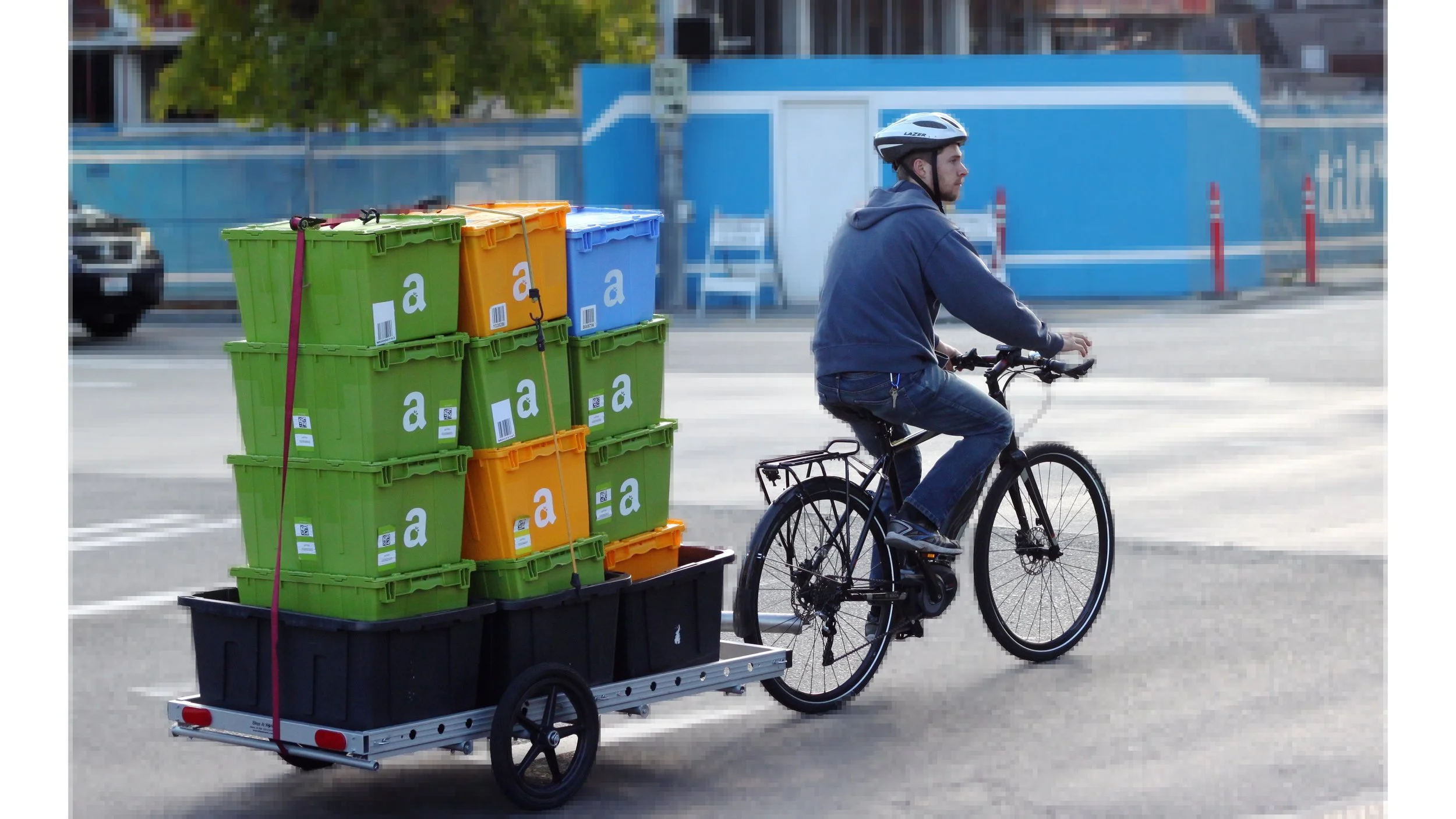
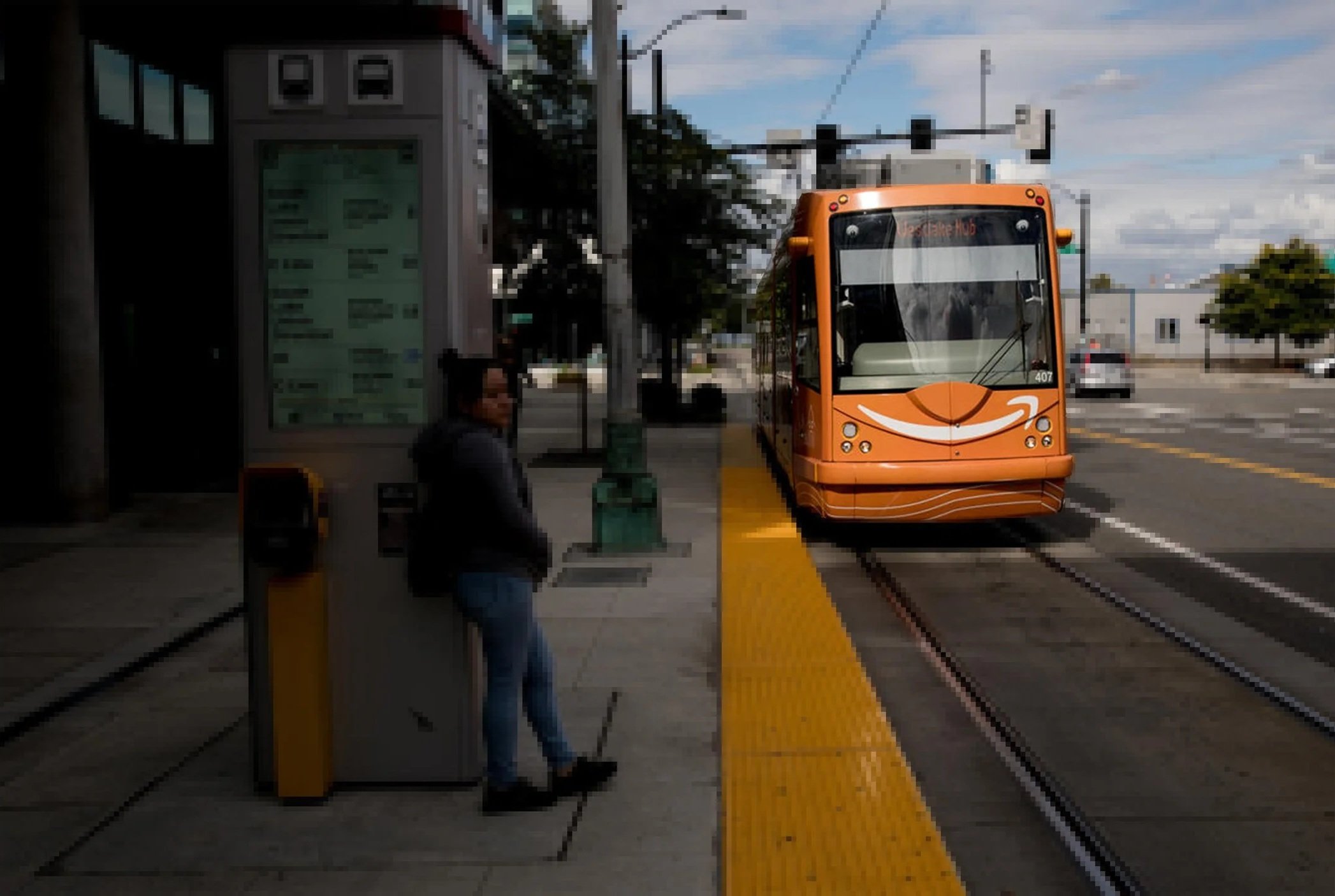
It is increasingly evident that corporate influence extends into nearly every aspect of daily life, from essential services to routine activities such as grocery shopping through corporate partnerships.
The normalcy of everyday events is increasingly shaped by single entities. The sites of the city remain familiar, but are now defined by branding that dominates the mundane.
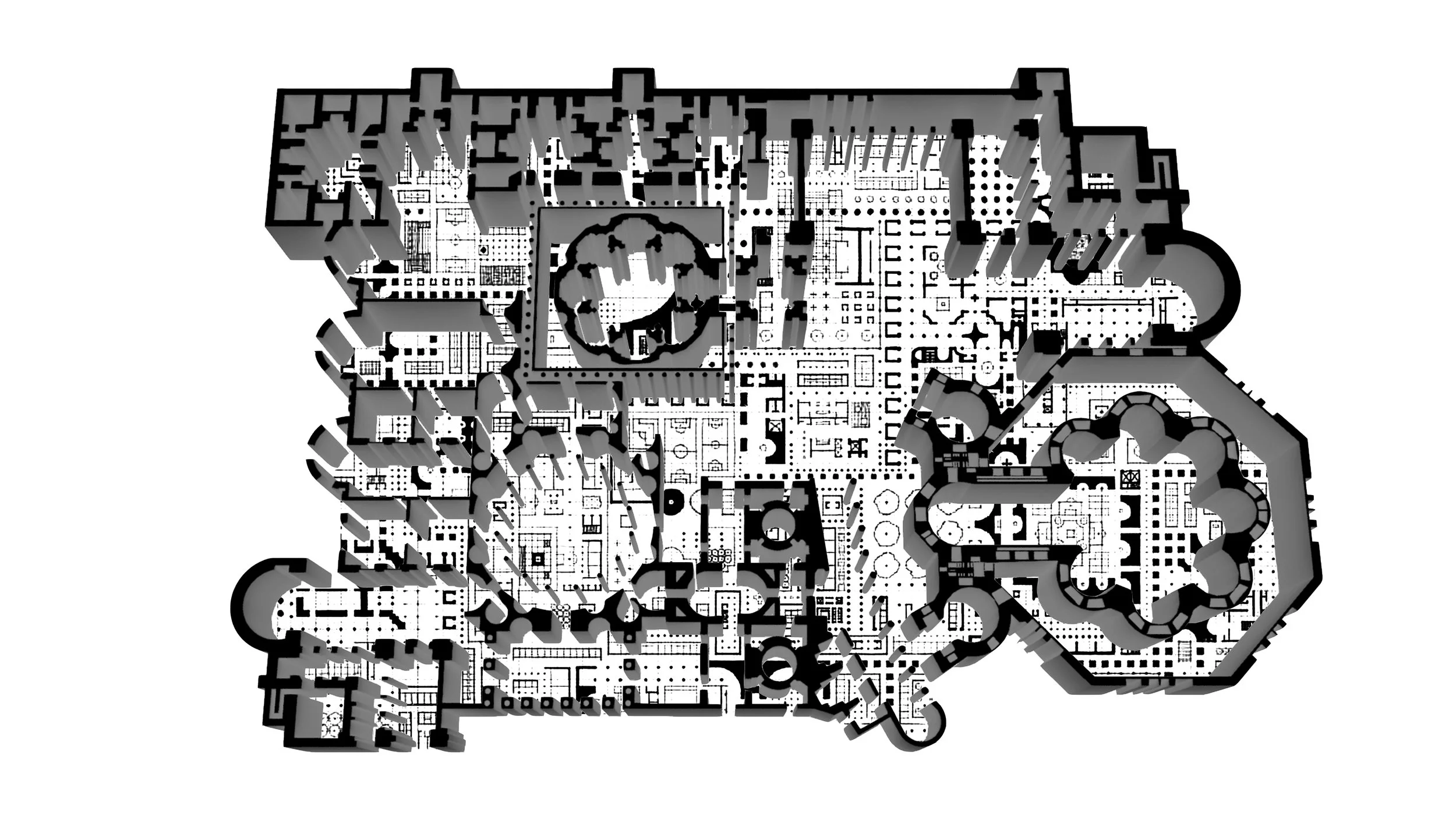
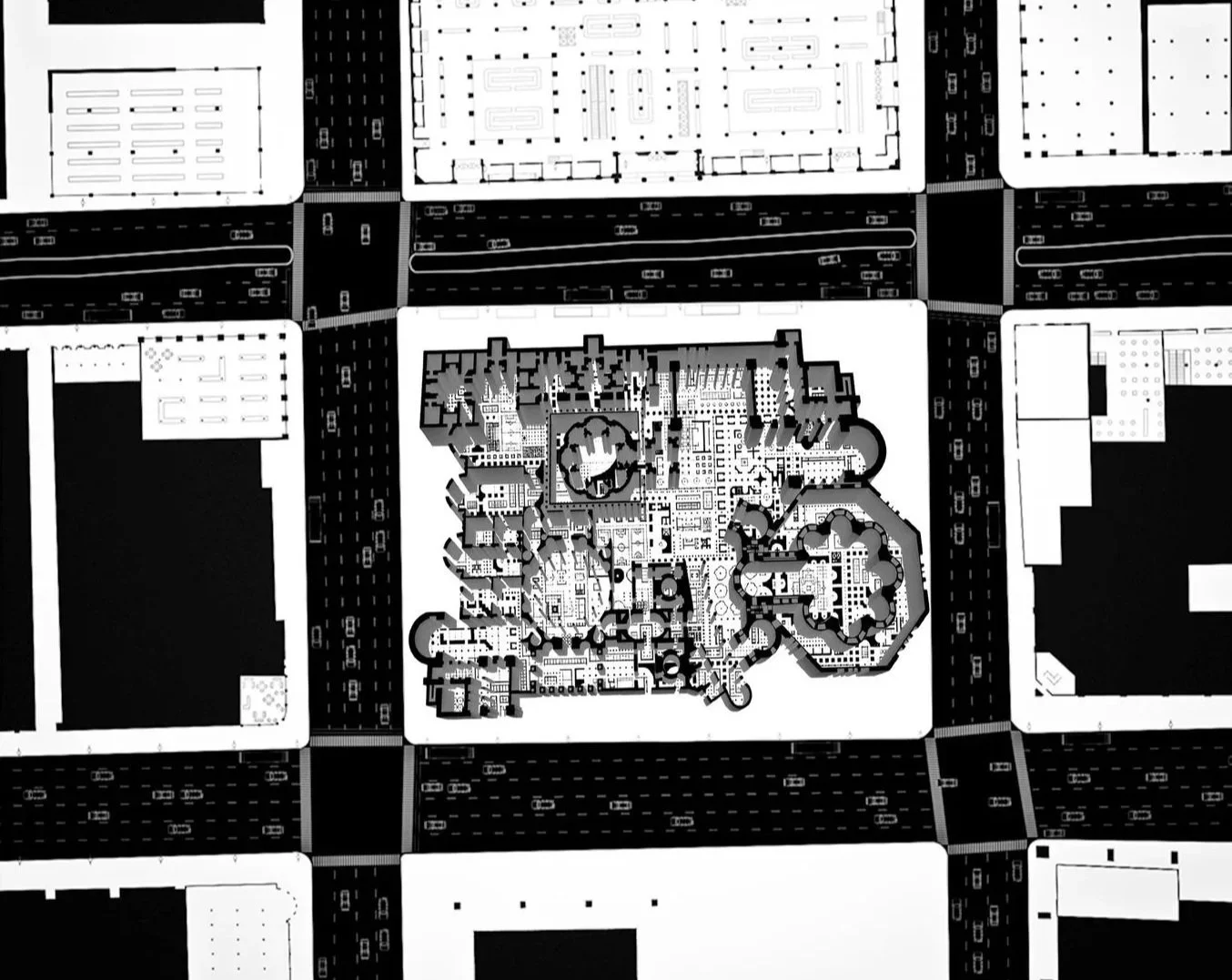
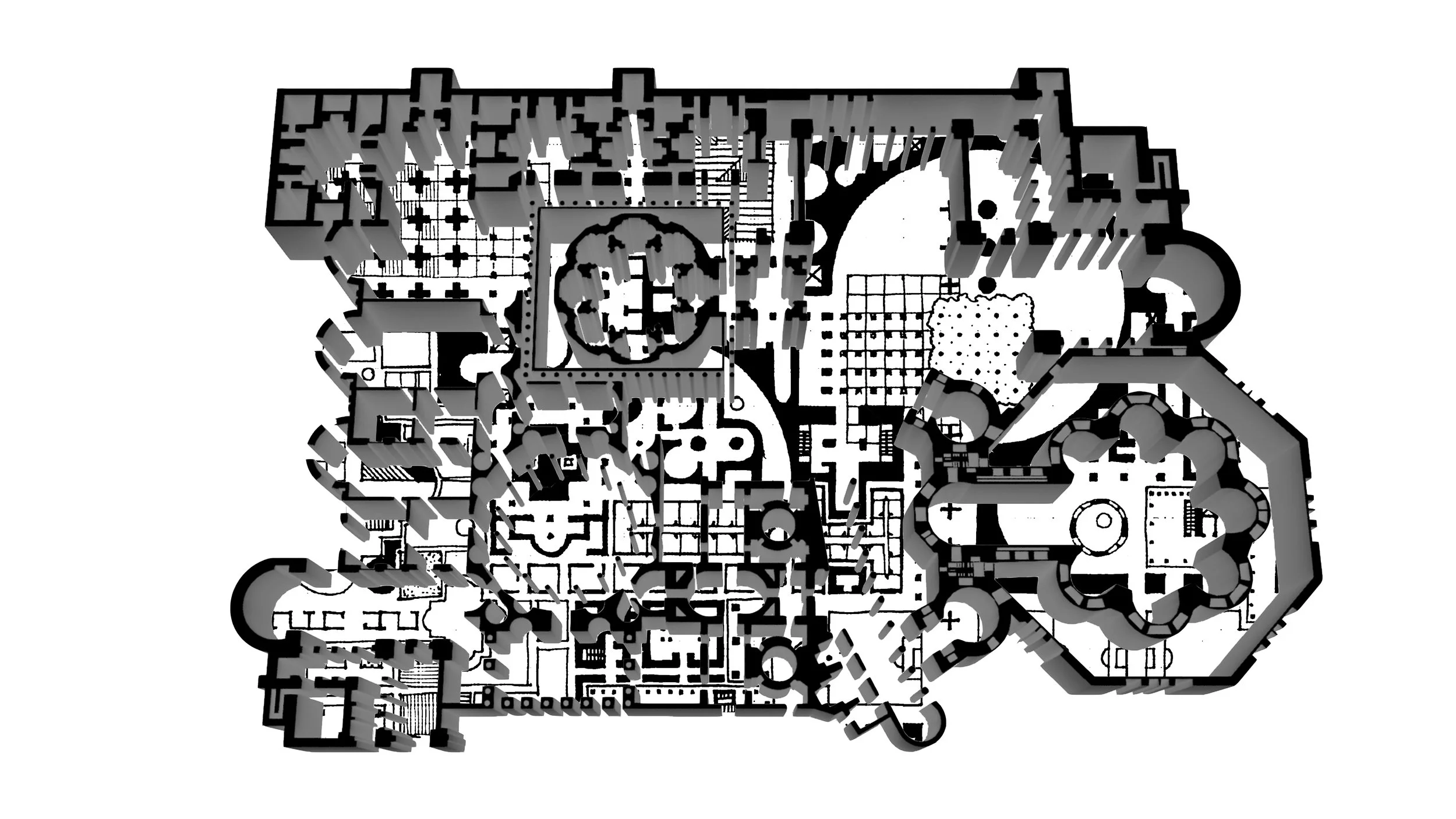
Whether or not participation is chosen, a company town remains exactly that—a company first.
The UnConventional Center
Seattle, Washington sets the stage for a city that functions as a collection of independent entities. This thesis investigates the convention center as a program through which an artificial environment can be constructed in and of itself. Conventional in its role as a civic centerpiece, its unconventional quality lies in its modes of representation.
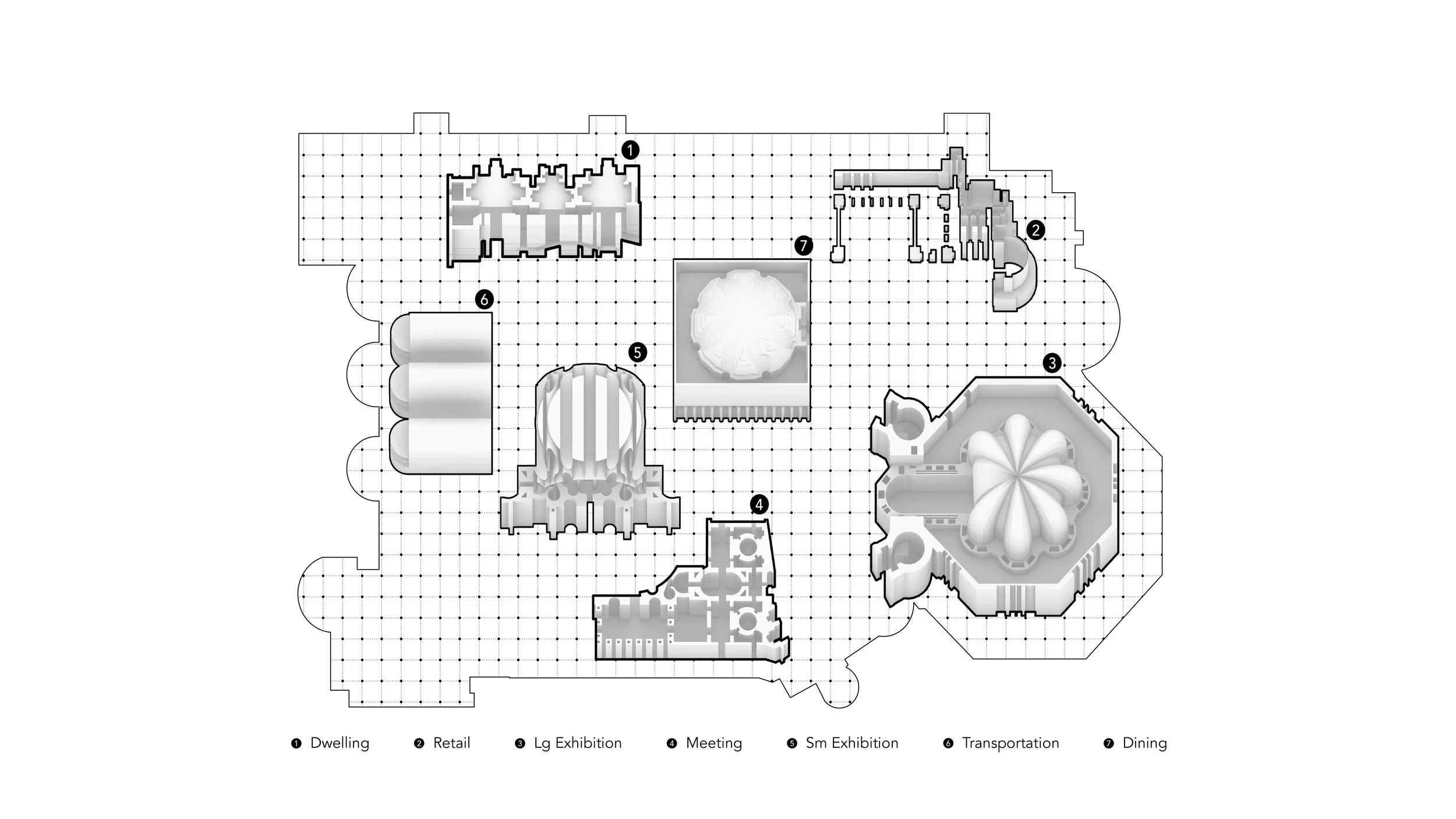
Various scenes are identified within the plan of the UnConventional Center, each corresponding to metropolitan conditions that collectively construct a city within the city. Recognizing varying intensities across the plan, the architecture produces enclaves of meaning and significance. These scenes operate as prototypes of an internalized urban condition.
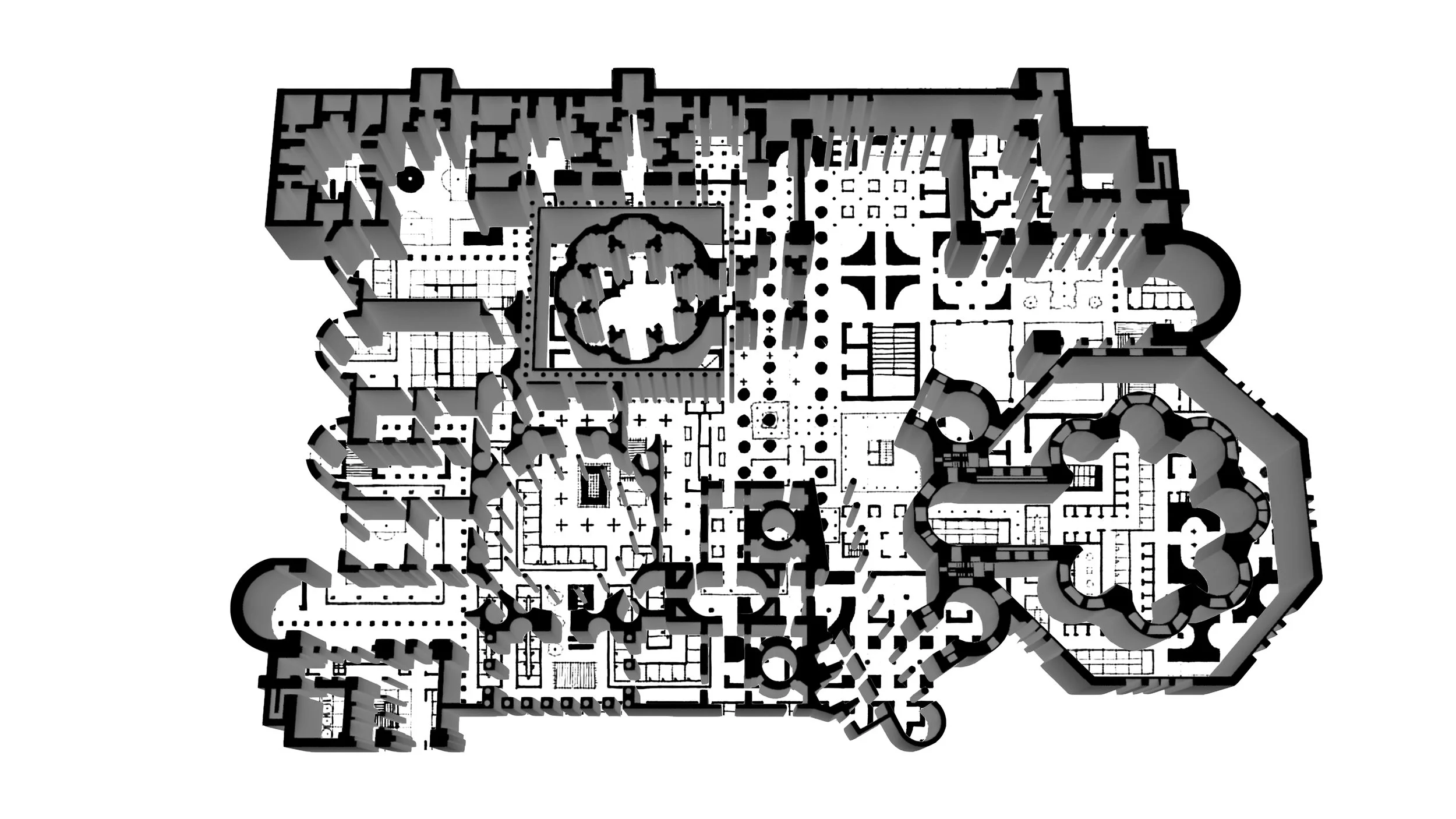
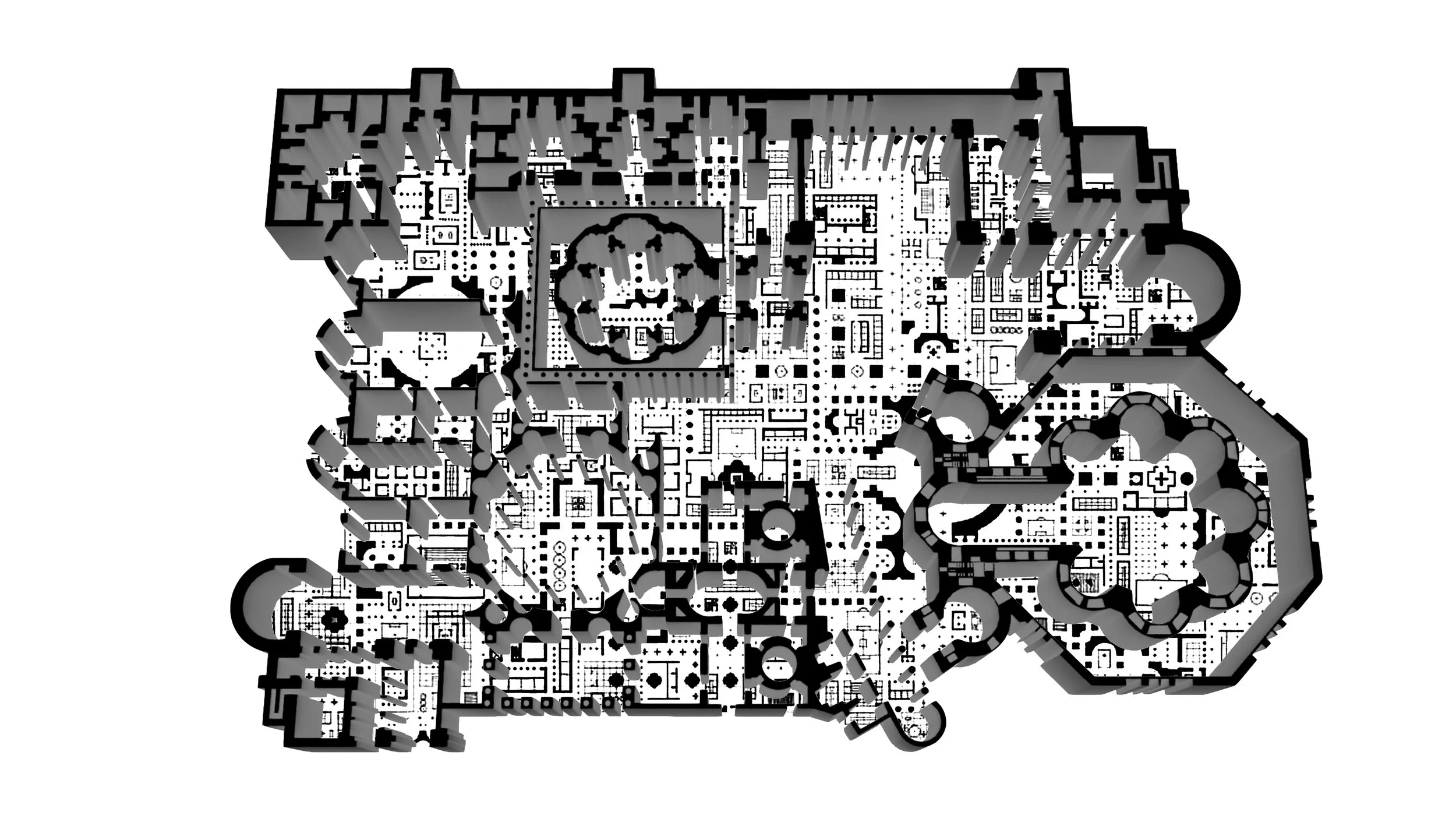
The plan of the UnConventional Center is composed of fragments of architectural plans. These elements range from monumental to banal, drawn from diverse historic and contemporary sources. Always fragmented, they form an architectural field that is complex, hybrid, and always shifting.
…and always shifting…
…and always shifting…
…and always shifting.
The city, as we have come to know it, is a homogeneous field. The qualities of its buildings are differentiated only by minute variation, to the point where they are effectively indistinguishable. The UnConventional Center seeks to undermine this condition by reintroducing architectural intensity back into the city.
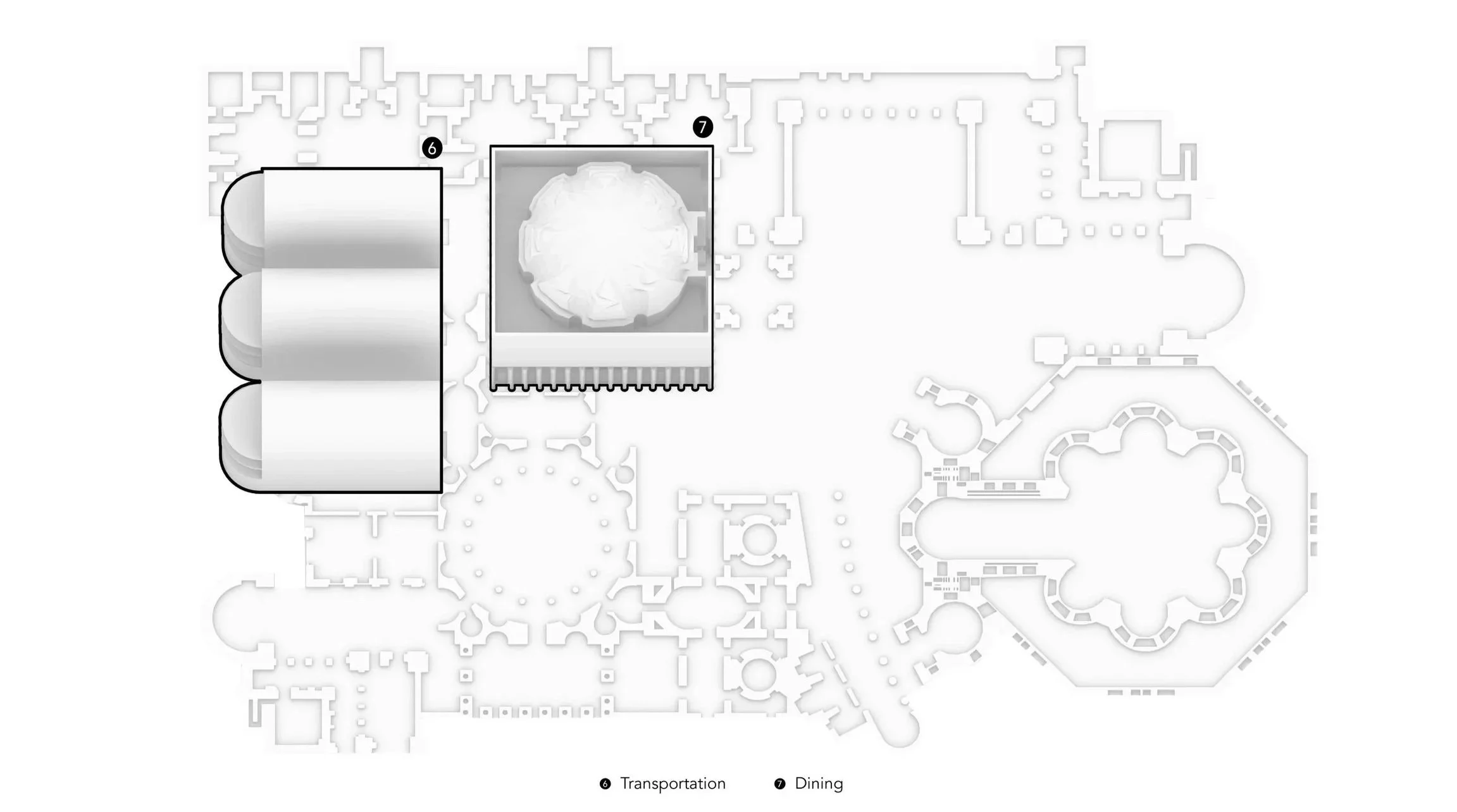
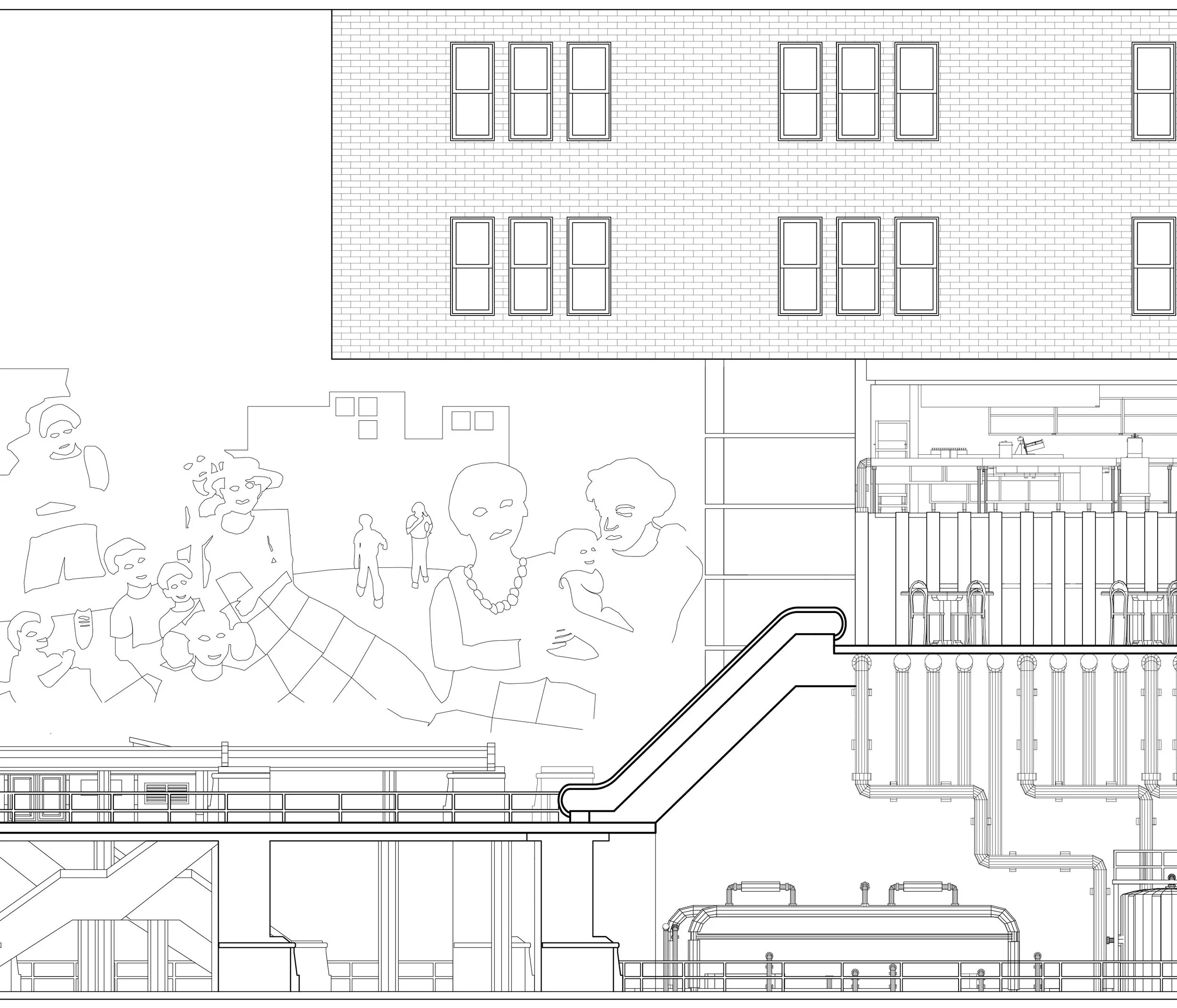
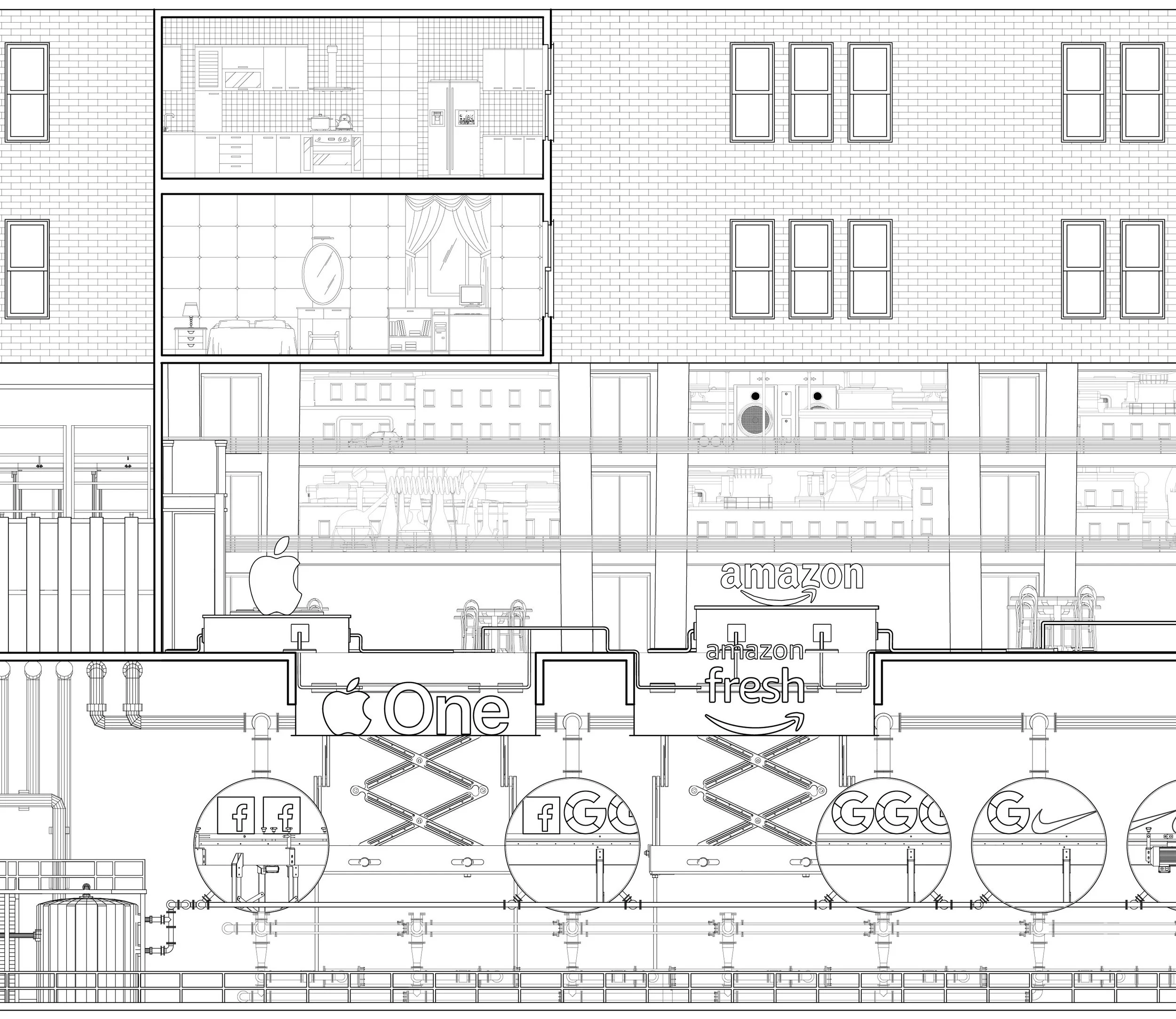
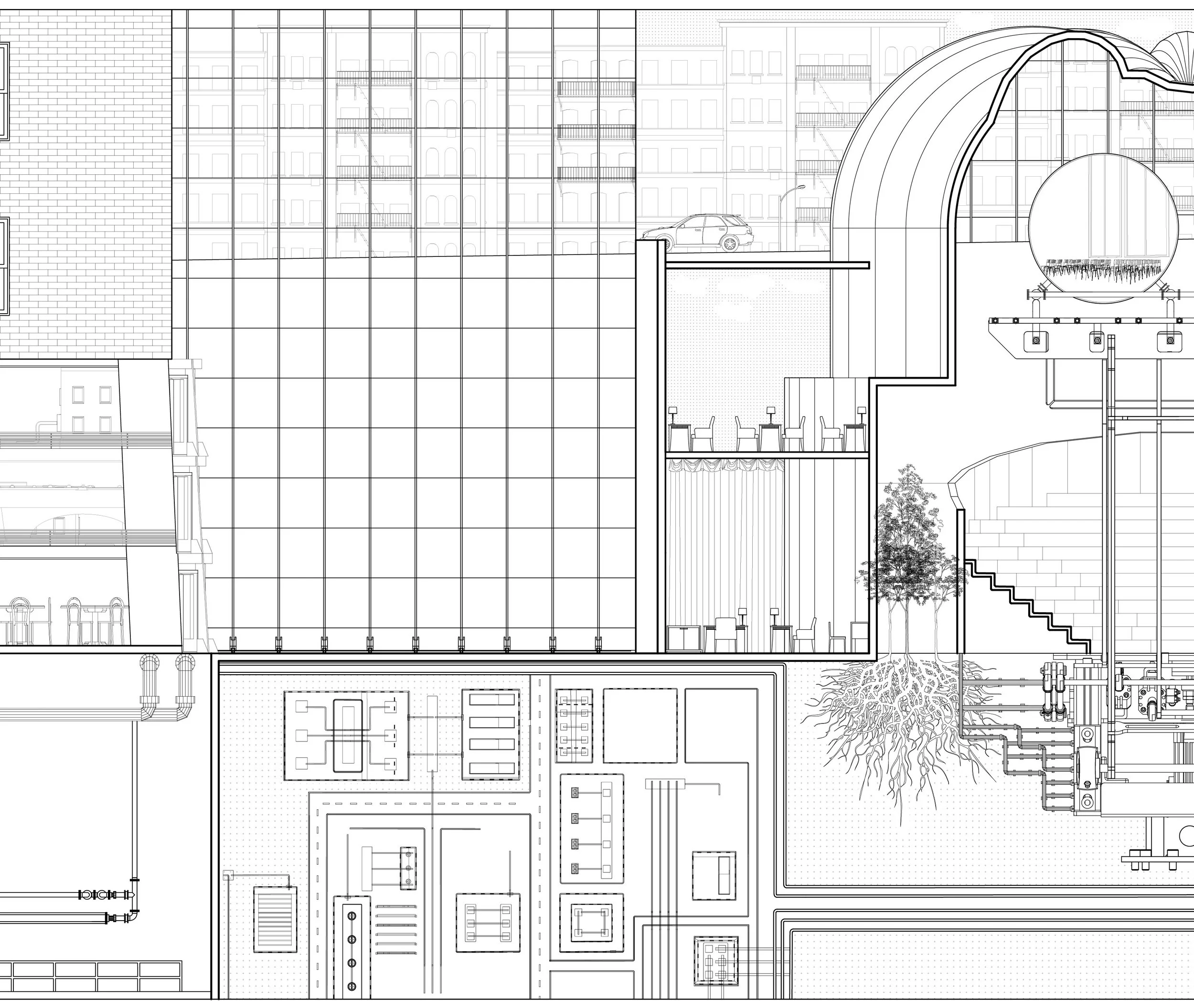
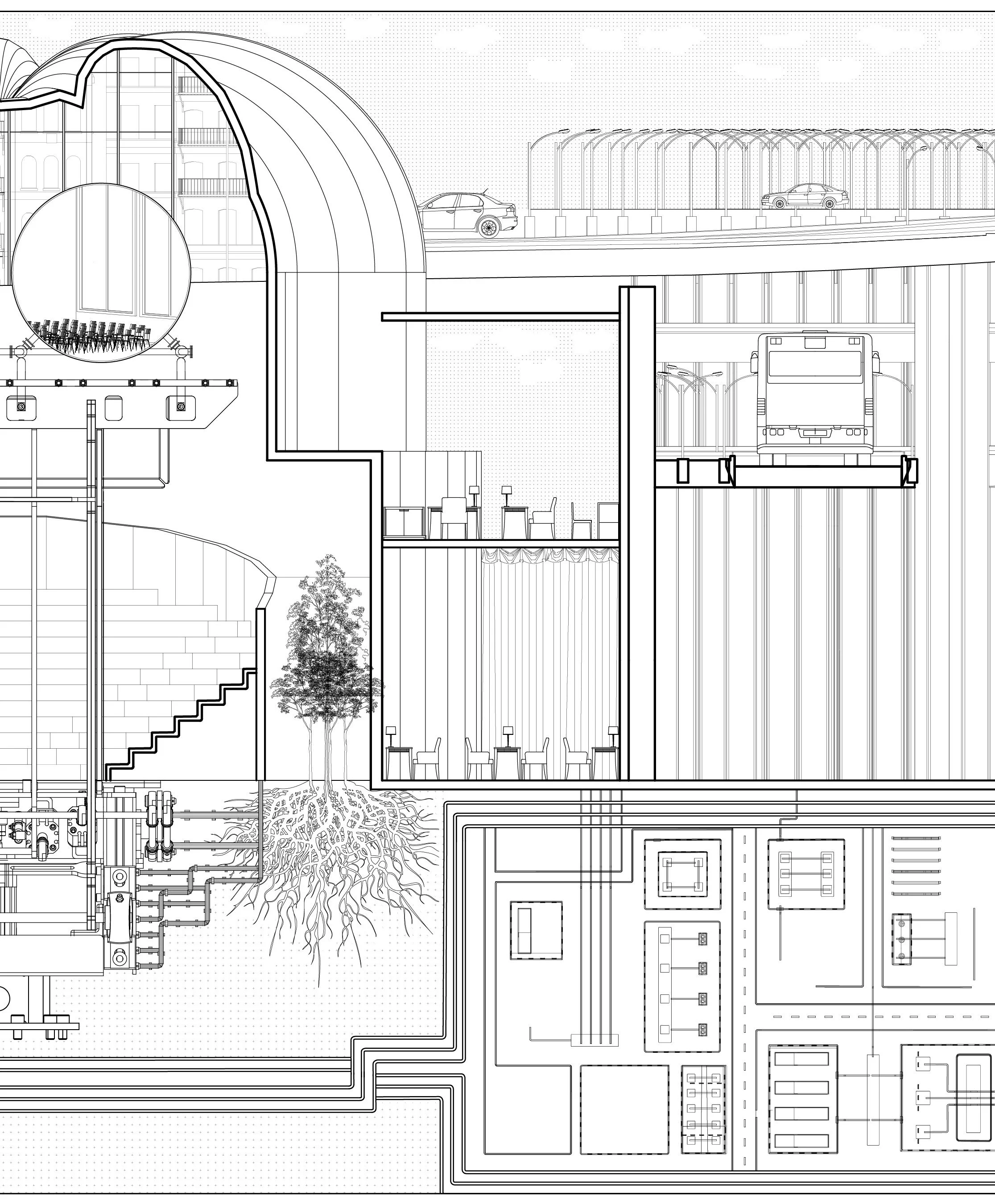
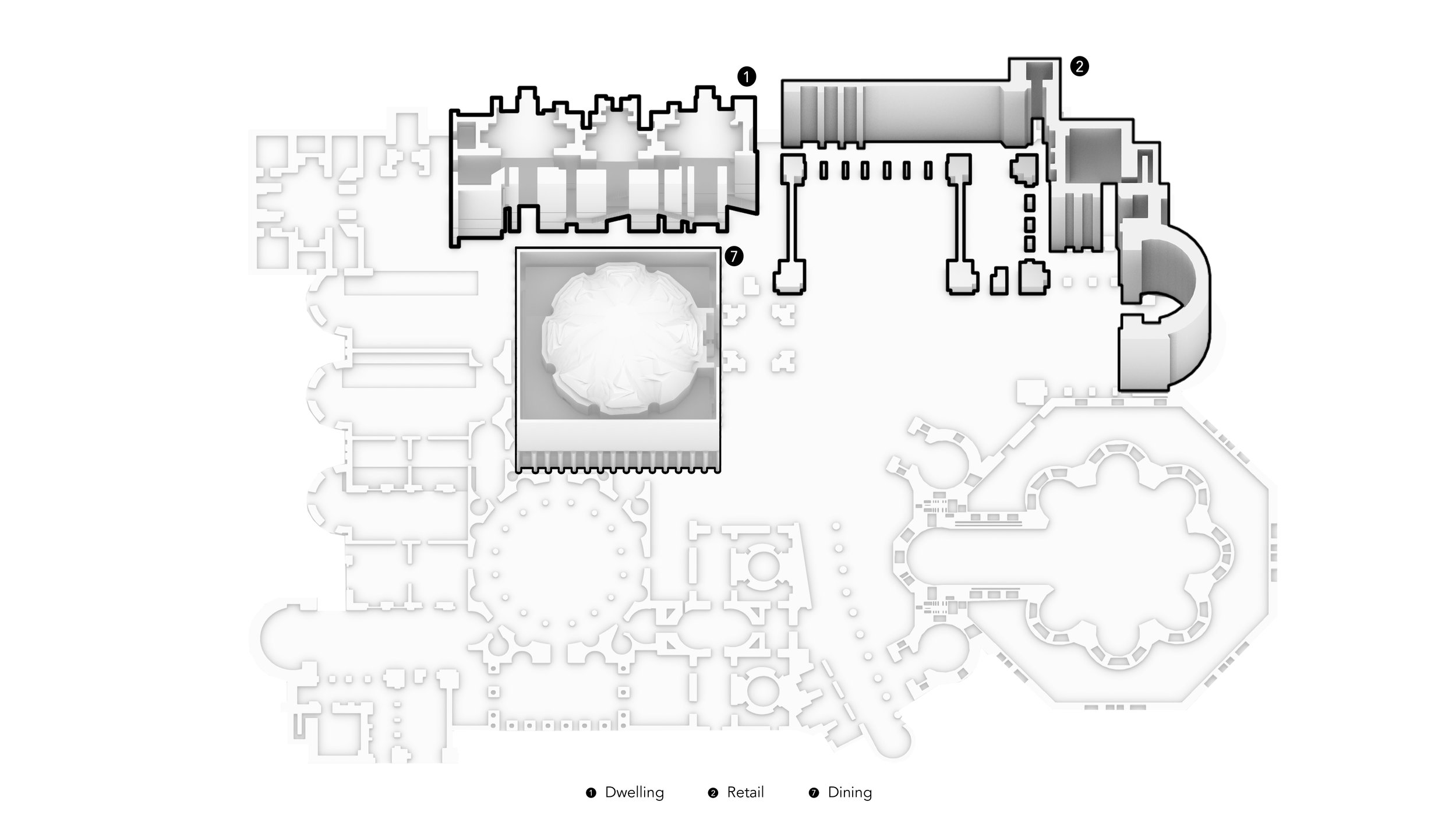
The plan of the UnConventional Center functions as a unified entity, while each element is articulated as a distinct architectural expression. It becomes a site that leads individuals into an abstraction and intensification of urban realities. In this project, the city is reduced to an endless sequence of interiors. The sequence begins with transportation and dining spaces.
Holding a condition of congestion through hybridized and stacked programs, the section locates transportation below, with dining and dwelling spaces above. Contemporary cities construct extensive infrastructure—transportation, utilities, and related systems—to support everyday domestic life, as reflected in the upper residential layers and their sash windows. Within Seattle, corporate systems exert a pervasive influence on daily life, shaping both visible and invisible connections that extend into the individual dwelling unit.
The next portion of the interior sequence focuses on retail spaces, with supporting dining and dwelling programs adjacent.
This section explores the constant exchange of information within retail environments. Individuals operate as continual consumers of the latest and most immediate forms of value, prompting the question of what an infrastructure might look like that remains aligned with rapidly evolving demand. Characterized by systems that continuously produce and adapt to consumption patterns, the environment shifts away from the static condition of the traditional shopping mall toward a networked field of connections defined by ongoing deconstruction and reconstruction.
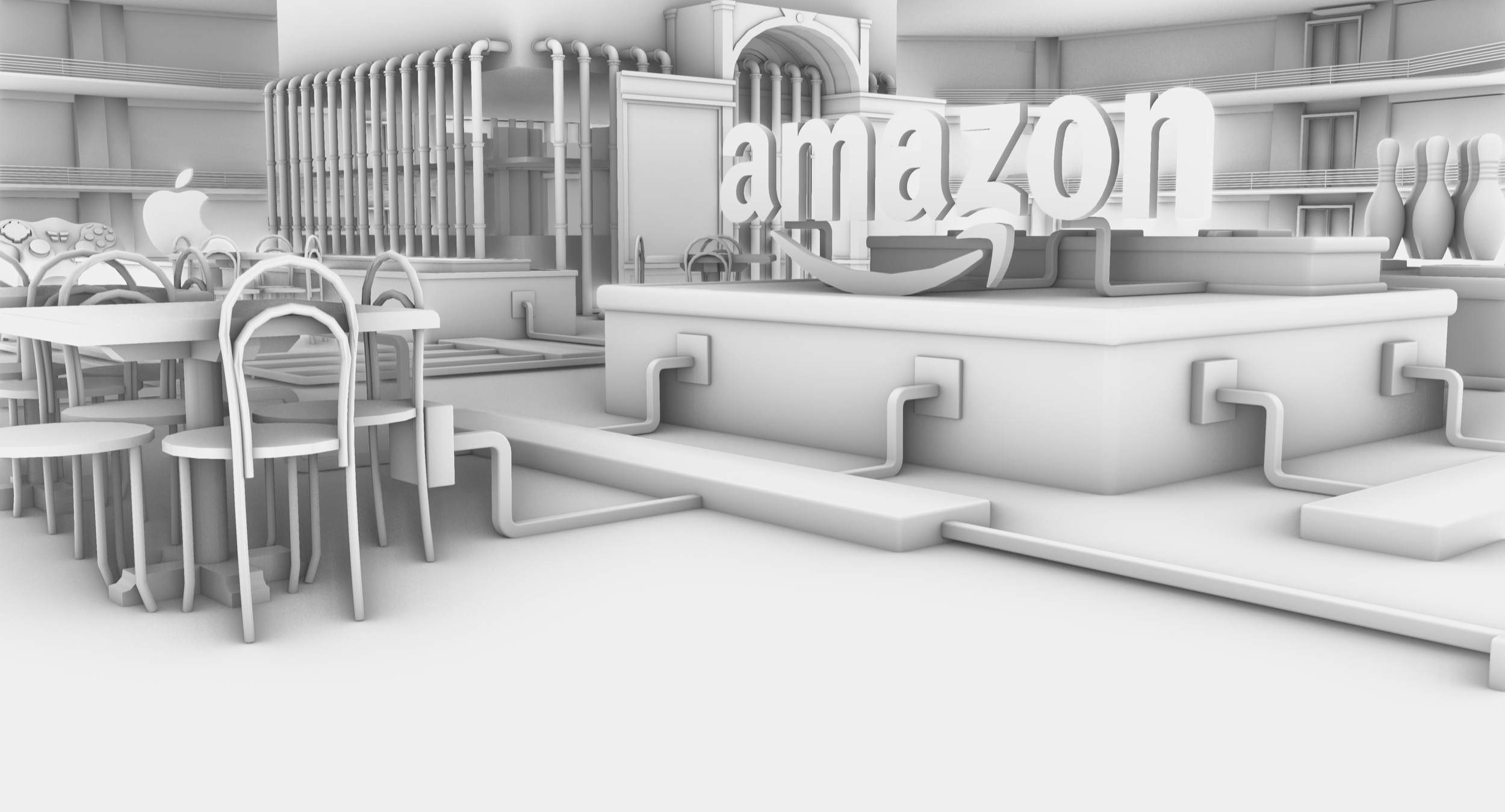
The shopping mall is often understood as a series of volumes that masquerade as a public environment. These retail labyrinths resemble city streets and adjacent businesses, yet strip away urban authenticity by removing the irregular conditions of the street. Producers and consumers are positioned within controlled environments that structure predictable use and performance. This retail area resists definition as a shopping mall, producing a condition of partial belonging where individual entities are defined and connections are made apparent.
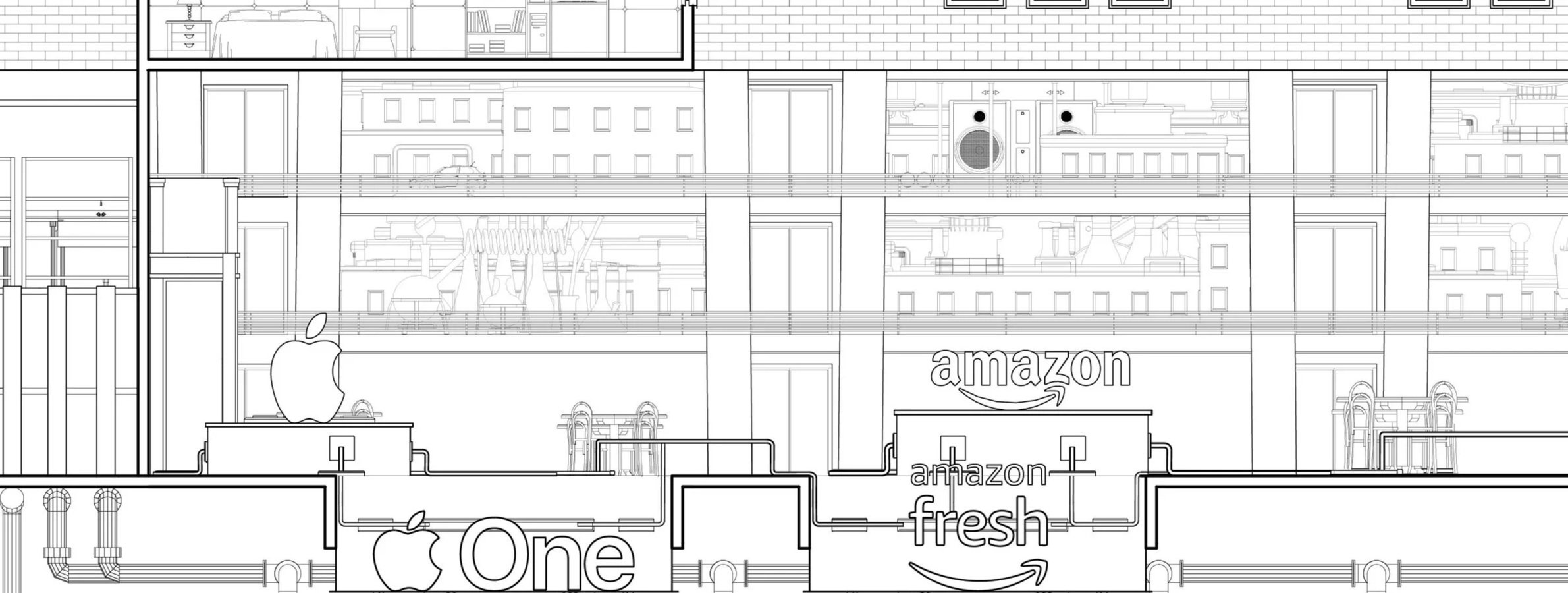
Taking a closer look at the retail levels, the project explores a netherworld of storefronts. Contemporary consumer culture is defined by rapid turnover and shifting expectations of tenancy, where retail identities are continually reconfigured over time. Reflecting this condition, the floors of retail offer a comparable variability to that of the street. Rather than discrete boxes, they form a continuous field of consumerism.
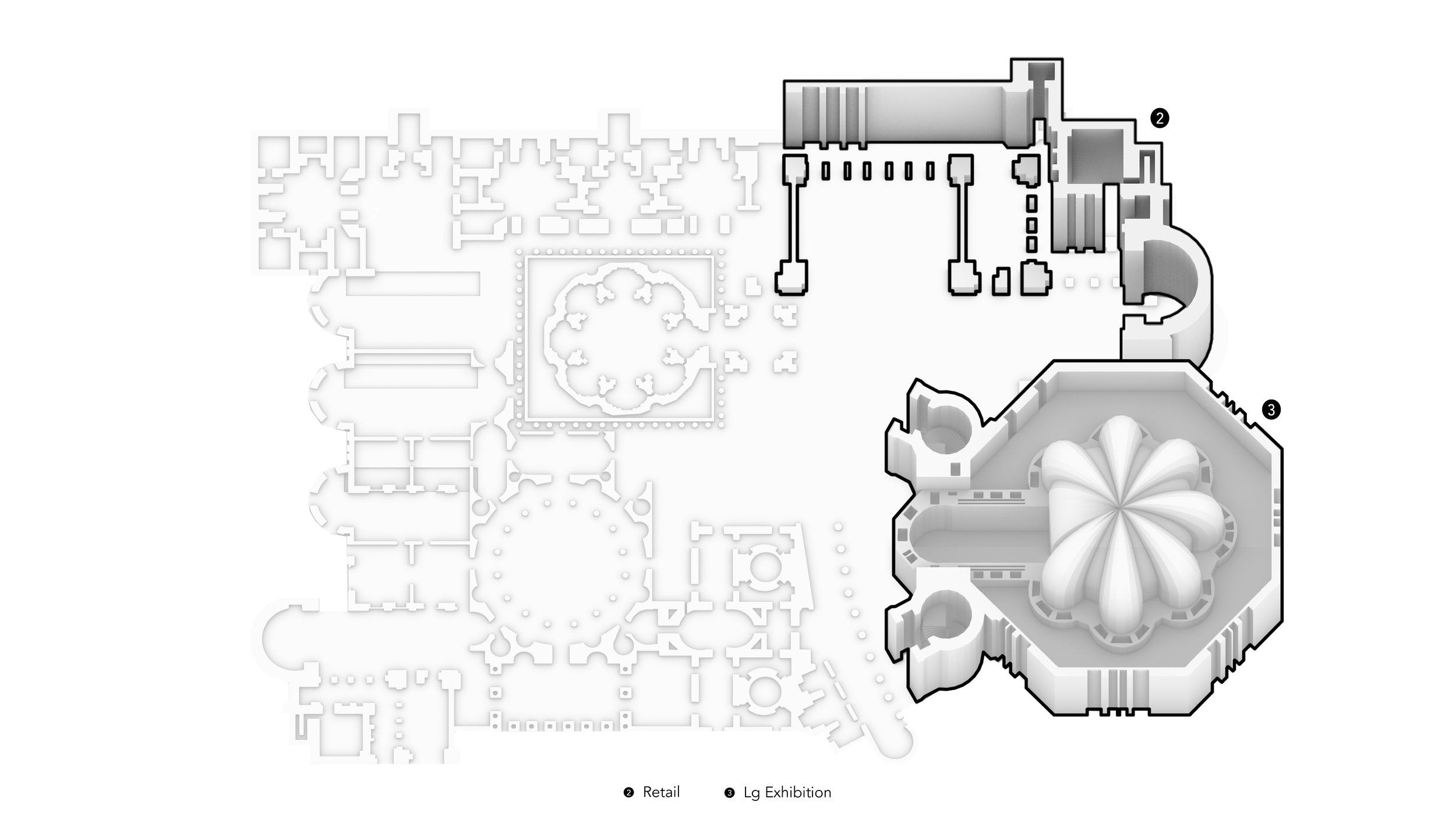
This third portion of the interior sequence examines a cut through the primary façade of the building, adjacent to the main convention space.
Located on a downtown block, the life of the city unfolds both outside and within the UnConventional Center. Responding to its surrounding context, the project examines the relationship between architecture and the larger systems that determine where and how it exists—from the infrastructural network of surrounding streets to the utility and natural systems below ground. Power resides in what is unseen, in the latent tendencies of objects and their interactions with one another.
Although observed as fixed objects, there is a constant circulation of information in perpetual motion. Focusing on the systems and devices that regulate commerce, communication, and contemporary life, these structures may appear to operate within discrete boundaries, but are in fact part of a larger speculative system in which so-called independent zones distribute and contain power in ways that often go unnoticed.

The contemporary city is a field of enclaves—continuous, distributed, and total in its condition.